
Visualize and build your AWS architecture diagrams in Vani
Vani's AWS diagramming Kit helps your team create clear, scalable AWS architecture diagrams to plan, design, and document cloud systems visually.
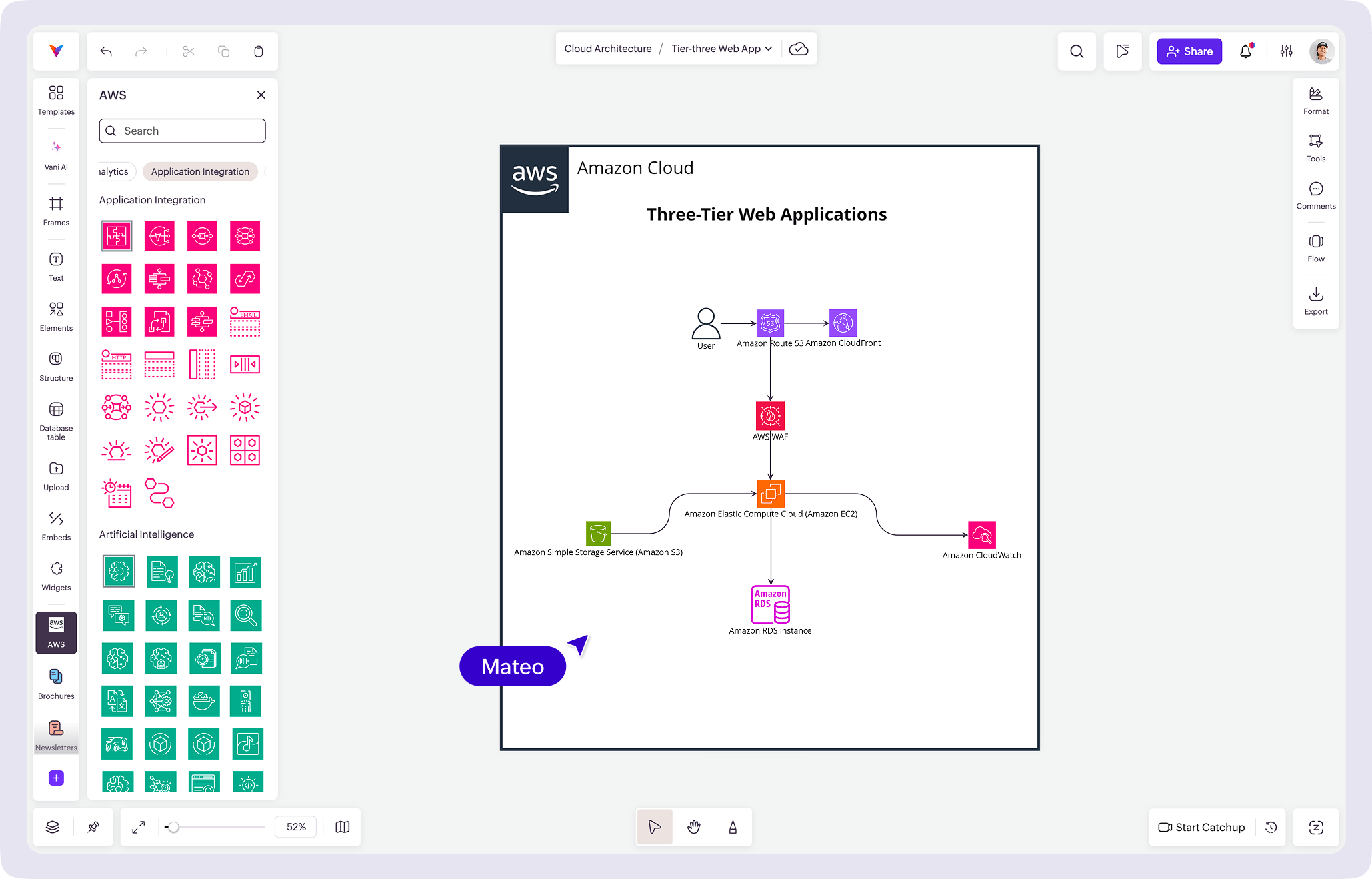
What is an AWS architecture diagram?
An AWS architecture diagram is a visual representation of how applications, services, and infrastructure are built and hosted in Amazon Web Services.
It helps teams understand how systems are designed, communicate infrastructure decisions, and document cloud architecture clearly.
In Vani, you can use the AWS diagramming Kit to map services, connections, and data flow in a structured visual workspace.
Why architects choose Vani for AWS diagramming
Map complex AWS architecture visually
Vani's AWS diagramming Kit includes a standard library of AWS service icons to help visualize components like compute services, storage, networking, and databases. Design AWS architectures easily using drag-and-drop icons on an infinite canvas.
Collaborate in real time
Create AWS architecture diagrams together with your team on a shared canvas. Comment on components and discuss architecture decisions without switching tools.
Keep your architecture documentation up to date
As your cloud systems evolve, update diagrams easily so architecture documentation stays accurate and accessible for your team.
What's in the Vani AWS diagramming Kit?
The Vani AWS diagramming Kit includes a comprehensive library of AWS service icons organized by category and ready to use.
Build architecture diagrams using icons for compute, storage, networking, security, analytics, and more.
How to create an AWS architecture diagram in Vani
-
Create a new Space in Vani for your AWS architecture project and organize diagrams by system, environment, or service.
-
Open the marketplace, search for the AWS Kit, and add it to your workspace to access AWS service icons.
-
Drag AWS components onto the canvas, arrange services, and connect components to represent data flow and dependencies.
-
Invite teammates to review the diagram, add comments, and refine architecture decisions together.
-
Export your diagram as a PNG or PDF to include in documentation, presentations, or technical reviews.