- HOME
- Technology & Trends
- SWOT analysis: How it works and how to enhance it
SWOT analysis: How it works and how to enhance it
- Last Updated : May 21, 2026
- 78 Views
- 5 Min Read

Strategic work has an awkward way of looking organized while actually living in different places at once. You might have a slide deck for leadership, a spreadsheet for campaigns to do, and even a chat thread for new ideas. Often, all of that information is written in convention only you understand.
This is exactly why SWOT analysis has stayed relevant for so long. It gives you a simple structure for looking at reality before you start arguing about solutions. HBR describes SWOT as one of the most ubiquitous tools in management and marketing, while CIPD notes that it's widely used as part of planning and decision-making across many different scenarios.
The core of SWOT analysis
A SWOT analysis is a planning framework for identifying strengths, weaknesses, opportunities, and threats around a specific objective. Strengths and weaknesses are internal factors you can influence more directly. Opportunities and threats are external conditions you need to respond to.
A fast way to understand it is this:
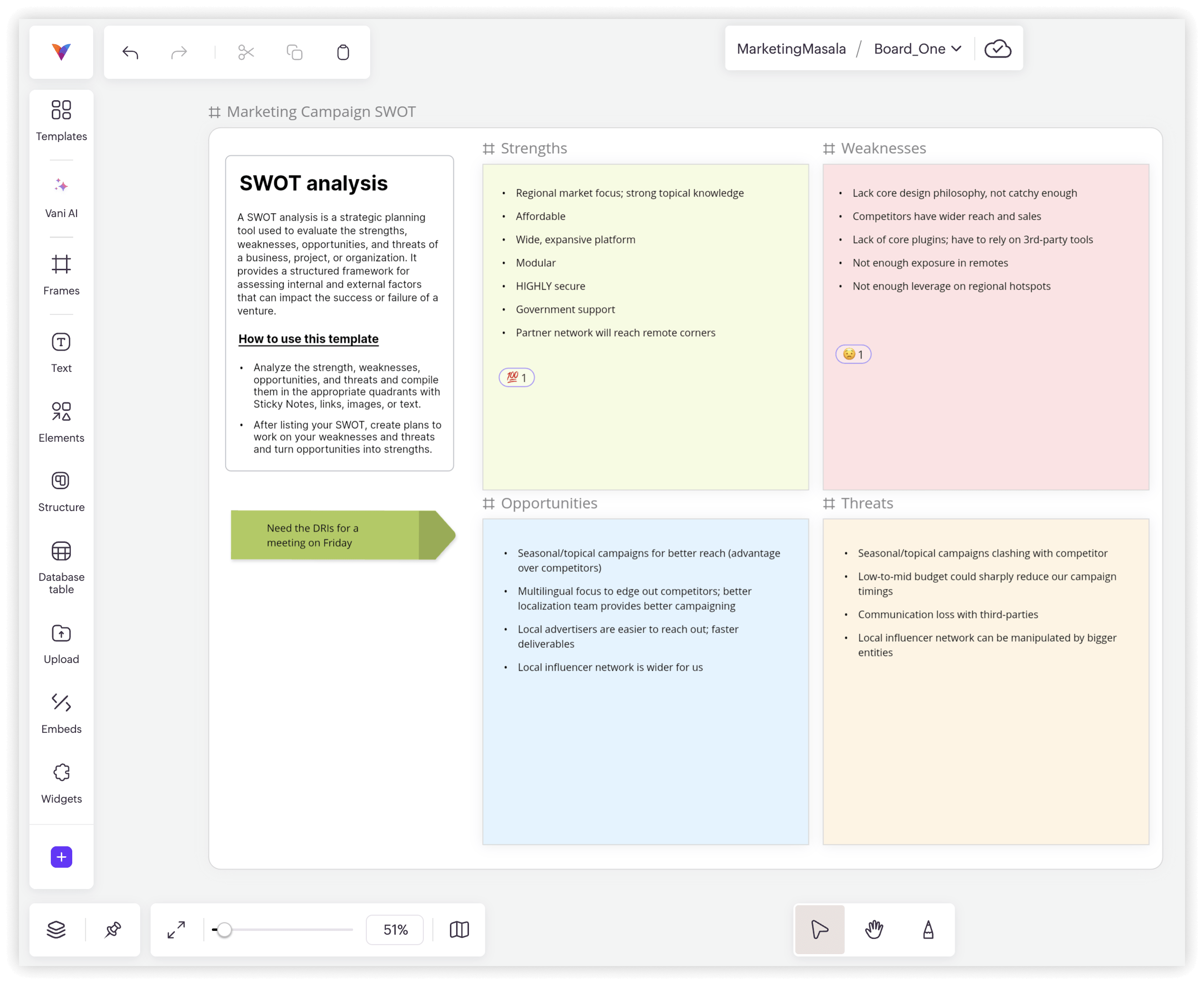
That simple grid is why SWOT is easy to teach. However, easy to create is not the same thing as easy to do well. CIPD emphasizes that a meaningful SWOT starts with a clear objective and often requires substantial time, resources, and team input. In other words, the four boxes are the container; the real work is deciding what truly belongs inside them.
It also helps to consider SWOT in layers:
Snapshot layer: What is true right now?
Sense-making layer: Which of those truths actually matter?
Strategy layer: What do we do with that information?
Execution layer: Which decsion-maker owns the next move?
That last part is where many teams stumble. CIPD explicitly notes that SWOT itself is mainly a way to capture information. The analysis and decisions come afterward, and that part is called TOWS, an extension to the SWOT analysis that further picks apart the situation’s issue on case-by-case basis. It is a strategic planning tool that is the next step following SWOT that moves your listed ideas into executable strategies.
How a TOWS matrix adds to a SWOT framework
Firstly, SWOT does a few concrete things for you:
It creates a shared situational view that is understood by anyone. Instead of each team showing up with its own favorite narrative, everyone works from one framework. That is especially helpful when you have cross-functional groups with different incentives, like finance fixing discipline or product management pushing for more speed in deliverables.
It forces you to separate what is inside your control from what is outside it. That sounds obvious, but it is one of the most valuable habits in planning. Teams could mislabel an internal issue as a market threat or treat an external tailwind like a core strength. SWOT helps clean that up.
Finally, it gives you a bridge into action when you convert it into TOWS matrix by helping you decide what your current goals are. Here’s the breakdown on how TOWS works:
SO (max-max): How can you use strengths to capture opportunities?
ST (max-min): How can you use strengths to reduce threats?
WO (min-max): How can you use opportunities to offset weaknesses?
WT (min-min): How can you minimize weaknesses and protect against threats?
It's a flexible way to understand immediate goals quickly, plan longer term goals, and maintain the bandwidth to scale with your requirements. It's useful for projects, organizations, and decision-making contexts beyond classic long-range planning.
How SWOT helps across industries
One reason SWOT has been around for decades is that it travels well across sectors.
Healthcare: In clinical and healthcare planning contexts, researchers have used SWOT to match the strengths and weaknesses of therapies or service models to patient-specific or system-level opportunities and threats, helping shape more individualized or context-aware strategies. More recent hospital-focused work has also used SWOT to assess the implementation of digital management centers in county hospitals and to identify follow-up strategies for execution.
Manufacturing: Manufacturing teams often use SWOT to weigh internal production capabilities, cost structures, and know-how against external market conditions, competition, and technology shifts. One manufacturing case study combined SWOT with the Analytic Hierarchy Process to help prioritize alternatives rather than leaving the analysis at a purely descriptive level.
Nonprofits: Many nonprofits begin strategic planning with SWOT so they can look at internal capacity alongside external community needs and economic conditions. That balance is especially useful in mission-driven organizations, where the right move is not always the one that looks best in a pure market model.
Yes, SWOT is absolutely a business framework, but it's also broader than that. If you need to compare internal capabilities against an external environment and turn that into a strategy conversation, SWOT is the way.
The W of SWOT: How SWOT can fail
SWOT can fail not because the framework is weak but because the process can be sloppy and tends to get tedious with more people involved. On the flipside, it can’t be created at the individual level at all.
A 2023 practitioner-focused study found several recurring problems: too many items in each quadrant, vague or ambiguous wording, confusion when a factor belongs in more than one category, and a lack of consistent structure in how the exercise is run. HBR makes a similar point more bluntly: the tool is familiar, but it is often used ineffectively.
CIPD also points out that a meaningful SWOT analysis cannot really be done well by one person working alone. It requires team effort, and poor assumptions can slow decision-making or send senior leaders into confusion on what to do next.
The practical fix isn't complicated, but it requires discipline:
Define the objective first.
Demand and save evidence for each item.
Keep duplicate topics out of the board. If they're necessary, explain why in two separate quadrants.
Limit each quadrant to the few items that actually drive decisions. Shortlist as aggressively as possible.
Convert that shortlist with TOWS choices.
How whiteboarding makes SWOT easier and more useful
This is where tools like Vani come into the mix. Vani provides teams with a whiteboarding space that can used collaboratively in real time without needing a meeting room (or a wide desk) to quickly start up a SWOT meeting. In fact, you can even utilize our default SWOT analysis template and start a deep-dive meeting right away!
The most important factor to consider is that using a whiteboarding app reduces the tedium in creating and maintaining the core framework of the analysis. You can revise, fix mistakes, and revert changes quickly, all with multiple people asynchronously collaborating on it. This lets you rest assured that everyone involved is on the same page and can move forward efficiently with the details secure in a digital environment.
Wrapping up
A SWOT analysis is useful because it turns scattered observations into a collaborative view of where you stand. Its real value is not in the four-box diagram itself but in the conversations, prioritization, and follow-ups that happen around it. With Vani, you can make this kind of collaboration a possibility and open a better, more streamlined method of moving projects faster with this time-tested framework.