- HOME
- Technology & Trends
- Visual collaboration vs. traditional meetings: Why modern teams are making the switch
Visual collaboration vs. traditional meetings: Why modern teams are making the switch
- Last Updated : February 27, 2026
- 133 Views
- 4 Min Read


Ever walked into a meeting room after a meeting has finished? What do you notice? Half-erased boards filled with information, sticky notes lying here and there, and notebooks left open with thoughts that may never be revisited.
Traditional meetings capture energy in the moment but struggle to preserve clarity afterwards. Conversations happen, decisions are hinted at, and ideas surface, but much of that context fades once everyone leaves the room.
In a world where work is faster, more distributed, and more complex than ever, that loss of context isn't just inconvenient—it's expensive. This is why visual collaboration is quickly becoming the standard for how modern teams work and why professionals everywhere are making the switch.
Meetings were built for a different era
For decades, meetings were the default way to collaborate because they suited a world where teams were co-located, projects moved at a predictable pace, and information stayed within a smaller circle. Today, work is diversified across locations, time zones, and functions, and decisions often need to be shared, revisited, and explained long after the meeting ends. Conversation alone cannot carry that load anymore.
This gap between discussion and lasting clarity is reflected in research, too. A Harvard Business Review survey of senior managers found that 71% consider meetings unproductive and inefficient and only 17% say their meetings are a productive use of time—not because collaboration lacks value, but because talk without structure rarely turns into shared understanding.
Why do traditional meetings fall short?
Meetings often feel productive in the moment, but when outcomes aren't captured in a shared, structured way, clarity fades and teams spend more time reconnecting dots than moving work forward. The challenge is rarely the discussion itself but the lack of continuity that follows.
Decisions start to drift
Without a shared reference point, people walk away with slightly different interpretations of what was agreed upon, which can slowly pull work in different directions.
Context gets scattered
Notes live in personal documents, chat messages, or memory, making it difficult for teams to revisit the full picture later.
Conversations are repeated
When prior thinking isn't visible, the next meeting often begins by reconstructing what was already discussed instead of building on it.
Ownership becomes less clear
Verbal agreements on next steps can blur over time, making it harder to track responsibilities and timelines.
Momentum fades between meetings
When progress depends on the next scheduled discussion, work stalls instead of evolving continuously.
What does visual collaboration change?
Visual collaboration doesn't replace meetings; it changes their outcome. Instead of meetings ending in notes, they end in shared understanding. The proof? According to 360 Research Reports, 39% of companies report improved alignment after adopting visual collaboration.
When teams work in a visual space together, ideas aren't just spoken—they're mapped, grouped, structured, and connected in real time. Everyone sees the same context forming as the conversation unfolds.
This makes a difference because people process visuals faster and remember them longer than text alone. Research from cognitive science and design studies consistently shows that visual information improves comprehension and recall. In practice, this means fewer follow-ups and fewer misunderstandings.
Core benefits of visual collaboration tools
Visual collaboration tools offer more than just a better meeting experience. They change how teams think, decide, and move work forward. Here's how they add value across the board: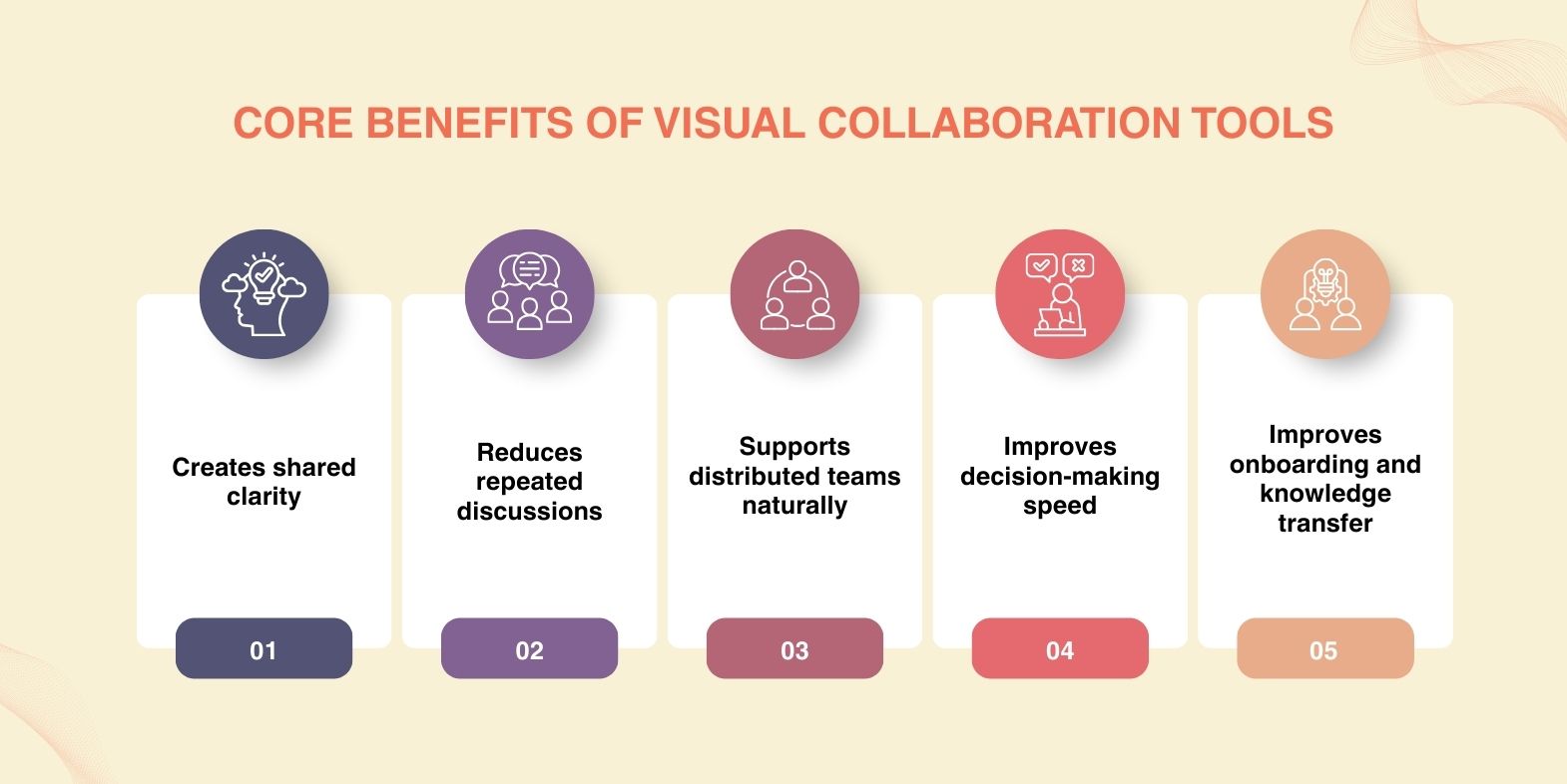
Creates shared clarity
When ideas are visible to everyone, teams interpret decisions the same way. This reduces confusion and keeps work moving in one direction.
Reduces repeated discussions
A visual workspace preserves context, so teams don't need to revisit the same conversations repeatedly. This saves time and helps momentum continue between meetings.
Supports distributed teams naturally
Visual collaboration works whether teams are together or apart, allowing members to contribute at their own pace while staying aligned on the same context.
Improves decision-making speed
When information is structured visually, teams can compare options more easily and move toward decisions with greater confidence.
Improves onboarding and knowledge transfer
When work is captured visually, new team members can quickly understand how ideas evolved and where projects stand. This helps them contribute sooner without relying on repeated explanations.
How different teams use visual collaboration tools
Visual collaboration tools are used widely across different teams in an organization, especially in today's hybrid and remote work environments. They make it easier for teams to come together, ideate, and align no matter where they are. Here's how different teams put them to use:
Marketing teams use visual collaboration tools to map out campaign ideas, plan content strategies, and visualize customer journeys, all in one shared space.
Product development teams bring together designers, engineers, and stakeholders to prioritize features, sketch user flows, and solve problems in real time without the back and forth.
Creative teams share mood boards, draft concepts, and exchange feedback visually, making it easier to align on a direction quickly.
Project managers use visual workspaces to map workflows, spot bottlenecks early, and keep everyone on the same page throughout a project.
Entrepreneurs and small teams organize business ideas, plan pitches, and map out go-to-market strategies visually so they can think faster and decide with more clarity.
Choosing the right visual collaboration tool
Not all visual collaboration tools are built the same. The right one depends on your team size, how you work, and what you need to accomplish together. Platforms like Vani are designed around this shift from conversation to shared visual thinking. Instead of capturing ideas after a meeting, teams build their ideas together in a shared workspace from the start. Brainstorming, planning, mapping, and decision-making all happen in one place, making collaboration continuous rather than momentary.
Wrapping up
The future of collaboration is visual. The workplace is moving away from meetings as one-off events and toward collaboration as an ongoing process. Traditional meetings won't disappear, but they're no longer enough on their own. The real shift happens when teams stop letting good thinking fade the moment a meeting ends. When ideas are visible, structured, and kept alive beyond the room, they turn into real outcomes. That's what visual collaboration tools make possible, and it's why more teams are choosing to work this way.
Happy collaborating!